
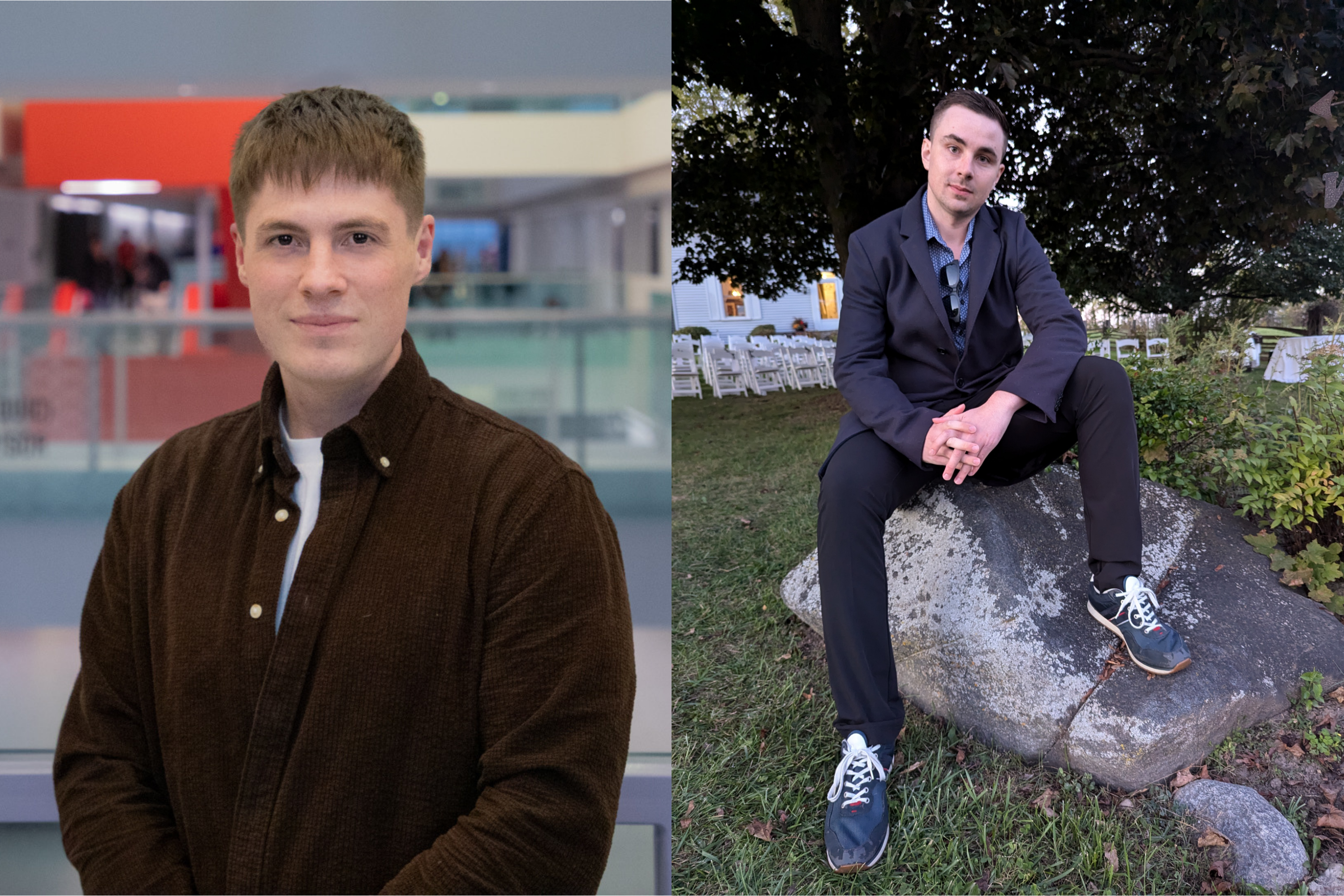
Every September, Smith Engineering welcomes brilliant young minds to its sector-leading program. Most come directly from high school — others bring life and industry experience to the table as they transition from other careers.
Richard Hart (above, right) and Ian Zentner (left) both came to Smith Engineering as experienced professionals and wound up teammates on their most challenging first-year project.
For Hart, technology and engineering have been a subject of interest since grade school. "As long as I can remember, I've loved technology," he says. "The first job I started at around 12, I set the money aside to buy parts to build my own computer. And I've always stayed interested in it, staying on top of new technology."
A native of Gananoque, just east of Kingston, Hart excelled as a student in Sheridan College's Computer Engineering Technology program, graduating with an advanced diploma. "It was a good experience for learning hands-on things, working with embedded systems," he explains. "I found a job in information technology," he says. "I was working with a managed service provider, a company that provides broad IT services to companies that don't have their own IT staff or infrastructure."
As Hart was developing a career in IT, Ian Zentner had finished a diploma on the west coast and was pursuing a path in the film industry. "I did a two-year technical diploma at Capilano University in Vancouver, and was offered work in a camera department in Montreal after my second year," he says. "I had been working in film since I was 17, and after Vancouver, I really committed to the camera department. I'm fully recognized as a union technician."
In both cases, soul-searching and reflection on career directions led Hart and Zentner to both apply to Smith Engineering.
For Zentner, it was a decision driven by the demands of the film industry. "The lifestyle in film is very difficult," he says. "I was never home to see my girlfriend, to see my dog. I started to think about why I got into film in the first place. Initially, I was interested in creative roles, but as I learned more about the technology, I became interested in the engineering behind all of it. When my partner took a PhD position at Queen's in biology, I applied, and it worked out!"
For Hart, the move centred on long-term career prospects, and how to use his skills to their full potential. "I wanted to work in engineering," he says, "and while I learned a lot at Sheridan, you could see that it takes a P.Eng to get into engineering positions — a diploma isn't enough to get you in the door." After researching schools, Hart chose Smith Engineering in part because of its QUIP internship program. "Queen's will open up a lot more doors, allow me to do a lot more networking," he says.
Both students entered the general first-year program in September 2025 — by coincidence, both worked on the "Artemis" project in the engineering course APSC 103, building a rover for lunar surface exploration under the mentorship of the Canadian Space Agency (CSA).
"Being from Montreal as a camera assistant for many, many years, our studios were around the CSA's office. I was always interested driving by. I thought it was a good chance to kind of get my feet wet and see what they were all about," Zentner says.
For Hart, this was an opportunity to push the boundaries of the project and spread his own wings. "Some of the earlier APSC 103 projects were things I was familiar with from college; a water filtration system, making a motor. This rover challenge, especially adding a LIDAR system, was way out of my comfort zone, a stretch goal."
LIDAR — a room-mapping technology — was not a mandatory part of the project, but an additional challenge to integrate into the overall task: to create a robot that could find and retrieve a soda can.
"There was a launch during the semester that fueled some motivation around the CSA project," Zentner says. "There were five people on the team, and with Richard having a lot of experience in IT, and being involved in the electrical components, his knowledge gave us the confidence to develop a more autonomous system than other teams might be able to. He spearheaded the electronics, I took on a more mechanical integration role."
Zentner feels he and Hart brought practical life and project experience to the team. "The younger teammates were very motivated and excited to absorb things, which pushed us into a problem-solving mentality where all the members were proactive and willing to take things on."
Smith Engineering is unique among Canadian universities: it guarantees students their choice of discipline after a general first year of engineering fundamentals. Both Hart and Zentner came out of first year choosing Electrical Engineering.
Zentner is looking forward to seeing how electrical engineering knowledge applies to the media technology he knows so well. Moving from industry to first year posed its own challenges: "I really got thrown into the deep end this semester and it was tough to get everything kind of under control. But I think it's purposely designed to make you realize you need to develop an efficient work ethic to get through this program."
"One of my professors at Sheridan referred to Electrical as 'the backbone of engineering,'" Hart says; as somebody interested in technology, particularly semiconductor development, and the evolution of AI, the department feels like a natural fit as he thinks about his future. "I might be looking at anything having to do with chip development or manufacturing work, or even a Master's degree," Hart says. "I'm interested to see where the industry is headed and the kinds of opportunities arise through things like AI."